 |
| 2 San Francisco Sourdough Loaves and 1 Whole Grain Sourdough |
I'm not going to be all encompassing here, as you can easily search and find out more info on your own, and I'm not an expert. In fact, after reading this, if you want to know more, there are some helpful links on my Pinterest board titled Sourdough.Wild Yeast.Levain. These words all refer to the same amazing fermented mixture of flour and water that is used to make bread dough rise.
We know there is yeast in the air and even on our bodies. When you mix flour and water into a paste, and let it sit, the natural yeast (and bacteria) that live around us will eventually find a comfy home in it and start multiplying. This power can be harnessed to rise bread dough, creating a sourdough loaf. The bread is really yummy and has some nutritional benefits also. Apparently these microorganisms trick the wheat into thinking it's been planted, thereby making its nutrients available. In the particular sourdough bread I make for my mom, who is intolerant to gluten, the work that the microorganisms do is strong enough that my mom can eat the bread. For a woman who loves homemade bread so much that she made it for us consistently (the regular commercial yeast way) when we were kids, this is awesome news! Also, we have noticed that bread made in this fashion has a lower glycemic index, keeping you full longer.
So, the idea is that you mix equal weights of flour and water, mixing it and keeping an eye on it until it starts to bubble. The air bubbles tell you it's growing. When it stops making air bubbles, it is hungry. You feed it with flour and water again. I use whole wheat flour. You get it on a feeding schedule so that you have enough for how often you bake. Once you use the part of it in baking, you feed the rest. I keep mine in a mason jar with the lid on upside down so air can get in and out. I actually don't put mine in the fridge at all. Although some people do.
After feeding it, I mark the top of it with a band, so I can easily know how much it grows.
 |
| This starter is hungry: not many bubbles. |
 |
| This starter has grown nicely: can see air bubbles, and it has doubled since feeding. It is ready to use. |
I currently use half a cup about every other evening to bake. This leaves me with about 1/4 cup. I feed what's left with a scant 1/4 cup water and a heaping 1/4 cup whole wheat flour (approximating equal weights), mixing each as I add. The next night I feed it that much again. So, the following night, it will be ready to use in baking, with some left over again.
Here are the instructions I followed when I started my sourdough start:
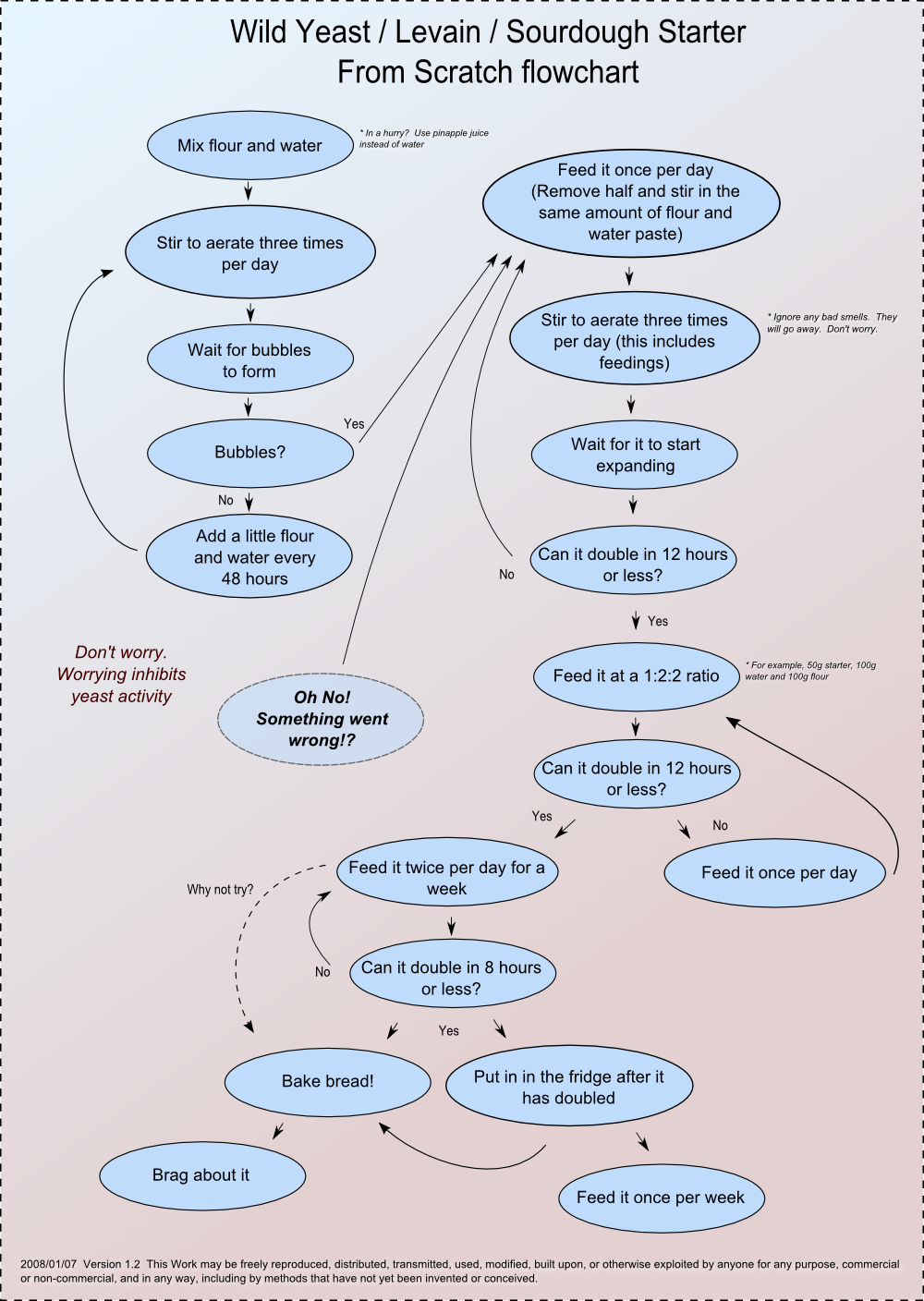
My friend Emily gave me some tips on when to feed the start and when it's ready to use. I wrote this up:
 |
| Should read wait 6 hrs on counter OR 12 hrs in fridge |
Although I didn't love the way this book was written, and I felt some information was missing or unclear, The Art of Baking with Natural Yeast, by Melissa Richardson and Caleb Warnock, was helpful.
I have often wondered how the pioneers made bread, because I always heard about them packing flour, salt, etc. I didn't hear of them packing yeast. I don't think you could buy commercial yeast in pioneer times. Anyway, I recently learned that our predecessors let their flour and water ferment to get the bread to rise.
Bread made this way has to rise a lot longer than one made with commercial yeast, hence the popularity of commercial yeast. For me, the switch has been easy. Our family likes the sourdough flavor and other benefits of the bread, and it is easier for me to plan bread well ahead of time than a couple hours ahead of time.
We may not think of food as being an heirloom item (recipes excepted), but I have read that some bakeries and families have kept a levain for up to a couple hundred years, passing it down through the generations. Maybe I'll be the great grandma in our family that passes this down!
I welcome your comments or questions. It's harder to write explanations than I thought. I would love to hear your experiences and tips, and I will edit this post to clarify anything if you just let me know.
Happy baking!

No comments:
Post a Comment